Tag: Luxury Motorworks

  • Beat The Heat!

    Beat The Heat!

    1/13/2005
    By: Roger Hewson

    Heat is detrimental to performance; it’s the entire reason behind cooler thermostats, front-mount intercoolers, cold-air induction systems and everything else on the market today designed to cool down something under the hood. Colder air being fed into the engine makes more power and that’s the reason we spent the better part of a Saturday with the crew at Luxury Motorworks watching them install their cold-air intake system and a heat shield on a customer’s Lexus GS300.


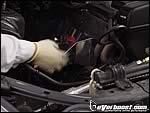
    After performing a routine service and inspection, Jose Garcia and Jesus Gonzalez began to disassemble the huge factory air box and remove the rubber intake tube running between the Mass Airflow Sensor and the throttle body.
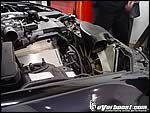
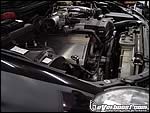
       

    Once the stock air box and rubber intake boot were removed it allowed access to the bolts on the cylinder head above the exhaust manifold that need to be removed to allow installation of the LMS heat shield.

    On rear-wheel-drive straight-six Lexus cars like the IS/SC/GS300 the intake system runs right above the stock exhaust manifolds. We’re no Toyota engineers, but wouldn’t an exhaust manifold that sees temperatures of 400 and 500 degrees possibly hear up the air running through the intake? Even with the stock heat shields there is no helping the intake boot and manifold.

    The beauty of Luxury Motorworks heat shield is not only in the placement of it, but also in the design. Instead of using a flimsy, single-wall sheet metal heat shield as a way to slow down the heat coming off of the exhaust manifold and heating up the entire intake system, LMS designed a double-wall barrier against heat to actually protect the intake tract against the heat as it attempts to radiate directly on to the throttle body and intake tube.
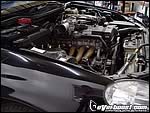

        

    It just happens this customer was replacing an existing competitor’s heat shield he was unsatisfied with. Another feature of the LMS heat shield is the forward thinking done by designing a cutout for their IS/GS supercharger kit into the front so no cutting or welding will be necessary if customers decide to get boosted in the future.
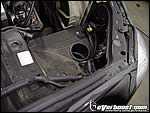
    Once the heat shield was securely bolted in place installation of the intake began. Because there is nowhere to run the intake a hole must be drilled right below where the air box was mounted. Like the saying goes, “Measure twice, drill as many times as you have to,” and after four or five holes Garcia had something resembling a circle in the right place.

    As we mentioned before, when it comes to performance heat is the enemy. The ideal source for an intake to gather its air would be a cool fresh place with a fairly consistent temperature so the computer wouldn’t have to constantly adjust things like mixture and timing every time you had to slow down for afternoon traffic.

    This is why the LMS intake system places the air filter directly below the stock air box. There is a constant supply of fresh, cool air which is not going to drastically change temperature like the air under the hood of the car. The area the filter sits in acts like an air box itself, muffling sound to some degree, protecting the filter from the elements somewhat, and so on.
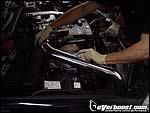

    The Dynamic Duo installed the new intake tube, along with a piece of rubber trim along the freshly cut hole and began to open the splash guard on the passenger side wheel well so they could install the conical air filter on the end of the intake tube.


    After a little feeling around the filter was on, tightened and this straight six was almost ready to use its new lungs. The GS was started, checked for fault codes, warmed up and checked again to make sure everything was ok. After being run for a few minutes the installation was double-checked one final time and the car was test driven and washed before being delivered to a happy owner ready to head out and discover some new found power.
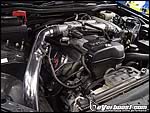
    The GS300 delivered an aggressive growl under acceleration, yet it was quiet during cruising and moderate driving. You could feel noticeable power gains at high rpm where the big straight-six began to run out of breath stock, especially in the higher gears. A little more work and there will be some unhappy GS400 owners out there.


  • I Am Lexus Hear Me Roar Politely

    I Am Lexus Hear Me Roar Politely

    12/8/2004
    By: Roger Hewson

    It’s no mystery that stock exhaust systems stink. No matter how good it might look or sound, there is something somewhere on most OE systems which makes them worth replacing. If this was not true we wouldn’t be writing this story, or the countless other exhaust install articles we have done.

    Our victim this time is a Lexus SC430. As many of you know, Lexus is not known for their hot rod V-8 exhaust systems- smooth and quiet are more their bag. Smooth we’re ok with, quiet we’re not. Luckily neither is anyone at Blitz. After researching the limited available choices for the SC430 we decided to give Blitz a ring and try out their system.

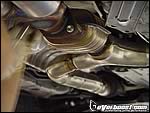
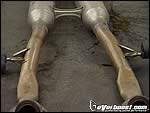
    The stock SC430 exhaust is not all that bad for a system that looks like it was run over by a forklift. Lexus decided to pinch the tubing on the system almost flat right before it bolts to the muffler. It’s an excellent decision when it comes to causing huge restrictions in exhaust flow and it’s just the thing you need to stunt top end performance. The beautiful matte black, road grime magnet of a muffler was the perfect edition to the pancake pipes positioned right before it. The factory Lexus muffler was doing everything in its power to fight off a throaty sound which is fine for the average luxury fan that needs to roll to Starbucks in stealth mode.

    Because the car is a Lexus and not a 1975 AMC Pacer, we figured we should have someone who knows what they are doing install the exhaust system on a car that costs more than our collective yearly editorial salaries. After all, you break it you buy it so we found ourselves at Luxury Motorworks again, because we didn’t want to be staring at each other wondering where these spare nuts and bolts go.

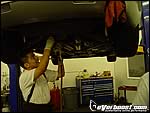
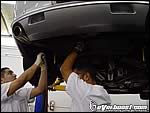
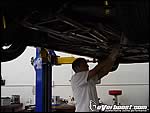
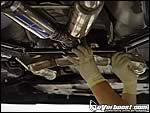
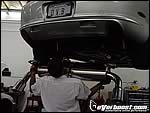
    Once at Luxury master technicians Jose Garcia and Jesus Gonzalez put the car on the lift and went to work at removing the enormous rear muffler and tailpipe section. Removal of the rear exhaust section was straightforward. They began by separating the stock rear muffler from the rest of the exhaust by removing the four bolts holding the flanges together. Next the left and right exhaust hanger brackets were unbolted from the body and the muffler assembly came down.

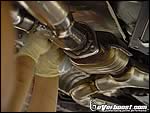
    Next, Garcia and Gonzalez began removal of the center section which bolts to the cat. Before the mid section—including the stock resonators—can be removed there is an underbody brace which has to be dealt with. Once out of the way the two bolts and nuts attaching the mid-section to the Y-pipe were removed and some WD40 was sprayed on the exhaust hangers so they would pry off and the piece dropped right down.

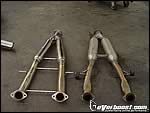
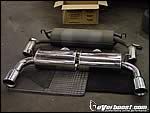
    When you place the stock exhaust next to the Blitz piece you can see why the stock pieces are so poor. The Blitz piping is slightly larger, but the bends are smoother for better flow and there are no unnecessary pinches or creases like on the stock system.

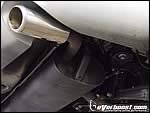
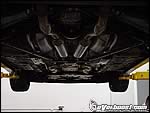
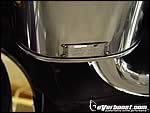
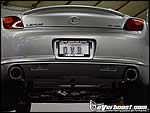
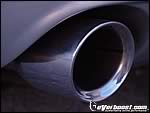
    The Blitz System uses dual mufflers, not just one big muffler with dual outlets. There is even a crossover pipe between the mufflers to help tune the sound and performance of the system. There is no comparison between the systems as far as looks go. The polished look of the Blitz exhaust is second to none and the plain stock look of the Lexus exhaust is, well, stock.

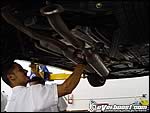
    Garcia and Gonzalez began installing the Blitz system by bolting up the center resonated section and hooking up the exhaust hangers. Once the first half of the Blitz exhaust was hung we could see what an excellent fit it was going to be.

    The Blitz rear section was hung then bolted up and everything was tightened to the correct torque spec. You do not want to over tighten exhaust flanges like these no matter how well they are built because they will warp, causing an exhaust leak or worse, the nut will come loose and the piece could fall apart.

    Once everything was bolted up the SC was lowered down and fired up so it could be checked for leaks, rattles and so Garcia could play car in the driver seat. The moment those eight cylinders fired up it filled the shop with the deep mellow throb only a V-8 can produce, something absent with the stock exhaust.

    On the road the SC430 emits a proper sporting exhaust note anytime the driver gets aggressive with the throttle, and a mellow burble while cruising. You can actually hear the car now where as before it was almost impossible to tell if it were running or not. The SC now emits the proper tone a mature sport coupe should; just loud enough to hear with the top up and mean enough that you want hear the V-8 rip to redline off of every stoplight. Not bad results for a couple hours in the garage.

404 Not Found